
The Mythic Images That Govern Woman
The Second SexThis thread follows the construction of feminine myths—from sacred nature and idealized beauty to mystery and danger—and exposes their service to masculine power.
increasing Bearing strength in each event
 decreasing
Bearing strength in each eventdecreasingThe Many Faces of Woman
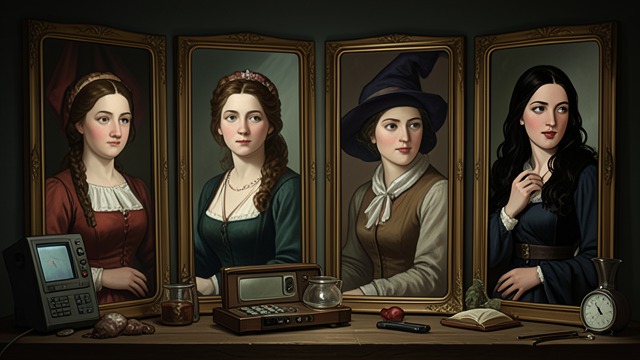
The Many Faces of Woman
Contradictory images
Woman appears in the myths as mother, virgin, servant, witch, muse, and destructive lover. These figures seem incompatible, yet each condenses a different hope or fear projected onto woman by a masculine imagination.
Myth as a social instrument
The contradiction does not prove that women possess an unknowable essence. It shows how a single category can be made to carry opposite meanings, allowing society to praise submission in one moment and condemn resistance in another.
Nature Made Feminine

Nature Made Feminine
Fertility and fear
The feminine is repeatedly aligned with earth, water, birth, and the continuity of life. These associations acknowledge real generative powers while also making woman seem like an impersonal force rather than a freedom with purposes of her own.
Reverence that contains domination
Worship of a mother figure can appear to honor women, yet the image remains defined by what men need from it. Once the power of nature is feared or controlled, the same symbolic system can turn fertility into impurity and the mother into a threat.
Beauty as Possession

Beauty as Possession
The body fashioned as object
The ideal of feminine beauty asks the body to appear passive, stable, and available to another’s gaze. Dress, ornament, and grooming can make the woman resemble a beautiful object, blending nature with artifice while concealing the living body’s change and vulnerability.
Desire within a hierarchy
The book traces how this aesthetic can flatter both partners while preserving unequal roles: man appears as the active chooser, woman as the prize. A woman’s own pleasure in adornment is real, but it takes place in a world where her social value is repeatedly measured through desirability.
Mystery as an Excuse

Mystery as an Excuse
Ignorance made into an essence
Calling woman mysterious can turn a man’s failure to understand her into a quality supposedly inherent in her. The label allows him to avoid admitting uncertainty and keeps her experience at a distance from ordinary human interpretation.
Silence and unequal power
The mystery is not simply a private secret shared equally by both sexes. When woman’s speech is ignored or her motives are treated as unknowable, social subordination is recast as metaphysical depth. The myth protects hierarchy by making communication seem impossible.
Replacing Symbols with Persons

Replacing Symbols with Persons
Refusing the fixed image
The argument rejects both the idealized woman who redeems man and the monstrous woman who threatens him. These opposites are not reliable accounts of women; they are paired roles that allow men to imagine themselves as essential while women remain defined in relation to them.
A more truthful encounter
A relationship grounded in reality would preserve poetry, desire, and difference without turning them into eternal laws. Recognizing a woman as a person does not impoverish experience; it makes room for reciprocal freedom, in which neither partner has to embody an entire symbolic universe for the other.
At the beginning of Volume I’s myths section
During the chapter’s account of maternal and natural symbols
In the discussion of erotic myths and feminine appearance
In Volume I’s final chapter on myth and reality
At the end of the myths analysis
